

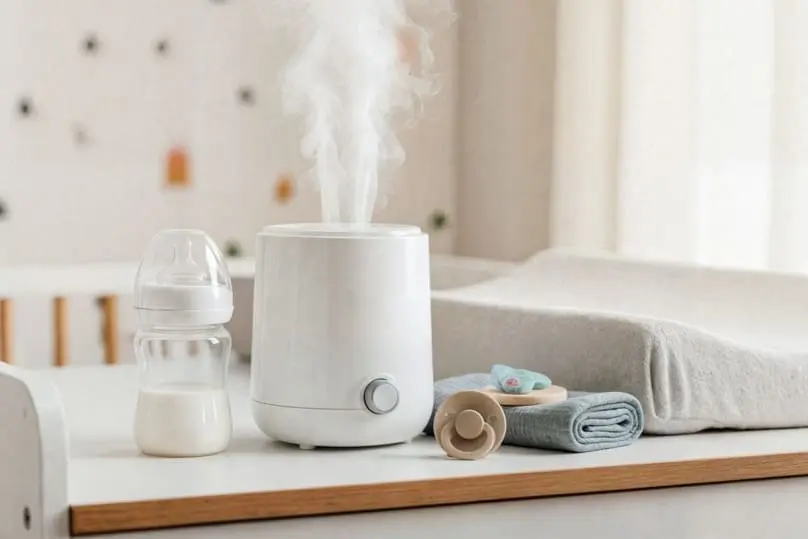
Air humidifiers add moisture to dry indoor air, but many people forget that they need to be cleaned regularly to ensure they remain hygienic and effective. Standing water and mineral deposits can leave you with a dirty tank instead of the comfortable room you expected. Learning how to clean a humidifier correctly helps keep that buildup under control.
If you are wondering how to clean yours safely, Yorleny’s Cleaning Services explains why it is so important and what supplies you’ll need. We’ll cover routine care, mineral removal, and the separate steps involved in disinfection.
Quick Steps: How to Clean a Humidifier
To properly clean your humidifier, unplug it and empty all the water. Check your model’s manual before choosing a cleaner or soaking removable parts.
- Disassemble and prepare the unit: Unplug the appliance to avoid accidents. Let warm-mist models cool first. Remove only the parts identified as removable in the manual; do not open the electrical housing.
- Remove mineral deposits: Use white vinegar or a descaler only if approved for your model. Follow its specified amount and soaking time.
- Clean hard-to-reach areas: Use a soft toothbrush or bottle brush to scrub the inside of the tank and corners. Handle delicate surfaces as the manual directs.
- Rinse with clean water: Empty all the vinegar from the tank. Rinse the reservoir and other washable parts several times as directed, keeping water out of electrical openings. Complete any required disinfection as a separate process after rinsing.
- Air dry: Place all the removable, washable parts on a clean towel and let them air dry completely. Storing the humidifier while damp can encourage microbial growth.
Important Note: Never mix vinegar, bleach, peroxide, or other cleaners. Keep the unit unplugged throughout cleaning and never run it with a cleaning solution inside.
Why Cleaning Your Humidifier Is So Important
Humidifiers release moisture in different ways; they do not all “evaporate everything” in the tank. Ultrasonic and impeller models can disperse minerals and microorganisms in their mist. Evaporative and steam models generally disperse less of these pollutants.
Mold and bacteria can thrive in damp environments, turning your humidifier into a potential source of air contamination if not cleaned properly. The U.S. Consumer Product Safety Commission (CPSC) warns that contaminated mist can cause respiratory problems, particularly for people with allergies or asthma.
Furthermore, if you don’t clean your humidifier regularly, mineral deposits can interfere with its operation. Honeywell’s maintenance guidance explains how scale can affect filters, heating elements, and the parts that produce mist.
How to Descale a Humidifier
Descaling a humidifier helps remove mineral buildup left behind by hard water. To descale it, unplug the unit, empty the tank, and apply white vinegar or the manufacturer-recommended descaling solution to the water-contact surfaces specified in the manual. Let it sit for the recommended time so the mineral deposits can loosen.
After soaking, scrub the affected areas gently with a soft brush or old toothbrush, then rinse the treated surfaces thoroughly with clean water. Let the humidifier dry completely before putting it back together or storing it.
There is no single vinegar recipe for every humidifier. The amount, dilution, soaking time, and parts that can be soaked depend on the model. Avoid scraping mineral deposits with a knife or other sharp tool.
Check which part you are treating before you begin:
| Part | Cleaning approach | Main precaution |
| Removable tank and tray | Descale and rinse as directed. | Use a dishwasher only if the manual allows it. |
| Wick or filter | Follow its separate care or replacement instructions. | Do not assume it can be washed or soaked in cleaner. |
| Electrical base and mist-producing components | Clean only the accessible surfaces identified in the manual. | Do not submerge the electrical base or scrape delicate components. |
For example, Vicks’ product support makes clear that cleaning procedures and dishwasher compatibility vary by model.
How to Disinfect a Humidifier Safely
If not cleaned, the moist surroundings inside the water tank and base can become breeding grounds for bacteria, mold, and mildew. Knowing how to clean a humidifier properly goes hand in hand with following its disinfection instructions.
The Difference Between Cleaning and Disinfecting
Cleaning removes surface grime; descaling dissolves mineral deposits such as calcium buildup. Vinegar used for descaling should not be treated as a substitute for a validated disinfection procedure.
On the other hand, disinfecting involves using a suitable product to kill germs on a cleaned surface. The Centers for Disease Control and Prevention (CDC) explains that cleaning comes before disinfection, and the disinfectant must remain wet for its required contact time. For a humidifier, the product must also be compatible with the appliance.
Step-by-Step Disinfection Process
- Disconnect and take apart: Unplug and turn off the humidifier before removing the tank and other detachable components. Make sure the electrical base never goes into water.
- Clean and rinse first: Remove dirt and mineral deposits, then rinse away the cleaner thoroughly before introducing a disinfectant. Emptying out the vinegar alone is not enough.
- Apply the recommended disinfectant: Use the product, dilution, and contact time specified for your model. Keep the surfaces wet for that time and ventilate the work area. Do not substitute a generic bleach recipe.
- Flush and rinse: Drain the disinfecting solution and thoroughly rinse the treated parts as directed. Keep rinse water out of electrical openings.
- Completely air dry: Place all removable, washable components onto a fresh towel, letting them dry fully before reassembly or storage.
Important Note: The Environmental Protection Agency (EPA) recommends following the manufacturer’s product instructions. Where no specific recommendations exist, its humidifier care guidance describes cleaning water-contact surfaces with 3% hydrogen peroxide, followed by thorough rinsing. This is not a universal contact-time recipe or a promise of complete sterilization.
Best Humidifier Cleaning Solutions
Distilled white vinegar can break down mineral scale when your model permits it. Choose a product for the task: removing scale and disinfecting are different jobs.
Vinegar vs Commercial Humidifier Cleaner
White vinegar is an option for compatible tanks and water-contact surfaces. A manufacturer-approved commercial descaler may offer pre-measured portions or a different formula, such as citric acid. Neither is automatically suitable for every humidifier.
For consumers who need ready-to-use, pre-measured descaling formulations or who wish to avoid the smell of vinegar, commercial humidifier cleansers may be an alternative.
- Advantages: Pre-measured products can simplify dosing when used as directed.
- Cons: An additional purchase is required, and the product still needs to be compatible with your model and rinsed out as directed.
Do not add cleaning drops, descaling tablets, or disinfectants to operating water unless the manufacturer explicitly approves that exact product for use during operation.
What Products to Avoid
The incorrect cleaning supplies can damage internal components or leave unwanted residues.
- Ammonia, rubbing alcohol, and other cleaners not approved for your model.
- Abrasive cleaners or tools that can scratch the tank or delicate surfaces.
- Essential oils, vapor rubs, or lemon juice used as improvised cleaning solutions. Accessories designed for a separate scent or medicine compartment do not belong in the water tank.
- Bleach at an improvised concentration. Some manufacturers permit diluted bleach for a separate disinfection step; it is not universally prohibited or universally suitable.
How Often Should You Wash a Humidifier?
For portable humidifiers in use, the EPA recommends daily water changes and cleaning every third day. Follow your model’s instructions for disinfection and component care as well. If you use hard water, you may need to address mineral buildup more frequently.
Daily Maintenance Tips
- Empty the tank: Unplug the unit, empty the water tank and wipe its accessible surfaces dry before refilling with fresh water. This helps prevent water from stagnating.
- Check the surrounding area: If nearby furniture or flooring becomes damp, reduce the output or stop using the humidifier until the moisture problem is resolved.
Regular Cleaning While in Use
Use the cleaning and descaling steps above every third day for a portable unit, rather than relying on a weekly-only routine. Follow any additional care required by the manual.
Distilled or demineralized water can reduce scale and mineral dust, as the CPSC recommends. It does not replace regular cleaning.
Filter Care and Seasonal Storage
- Filter replacement: If your humidifier has filters, be sure to replace or clean them according to the manufacturer’s recommendations. Do not apply the tank’s vinegar or disinfectant procedure to a wick.
- Component inspection: Regularly inspect the humidifier’s parts for signs of wear or mineral buildup and replace them if necessary.
- Storage: Clean and dry the unit before putting it away, and clean it again before seasonal reuse. Replace consumable components as directed.
Common Mistakes When Cleaning a Humidifier
These are some common cleaning mistakes people make when cleaning air humidifiers:
- Waiting too long before cleaning the humidifier.
- Using products or concentrations not approved for the model.
- Not rinsing the humidifier properly after cleaning it with vinegar or another approved cleaner.
- Storing the unit before all parts are completely dry.
- Not checking and replacing the filter regularly.
- Treating descaling as disinfection, or mixing products instead of rinsing between separate treatments.
When to Replace Instead of Clean
When you see persistent buildup that the approved procedure cannot remove, recurrent mold and mildew, or mechanical failures such as cracked tanks or motor troubles, stop using the unit and contact the manufacturer about repair or replacement.
Replace a moldy wick or other consumable part as directed. If contamination remains in inaccessible areas, do not keep running the humidifier or attempt to solve it with stronger chemical mixtures.
When Humidifier Maintenance Connects to Home Cleaning
Managing Humidity in Florida Homes
Knowing how to clean a humidifier is only part of using it appropriately in Florida’s climate. If you notice mold returning quickly inside your tank, review its maintenance and storage first. That finding alone does not prove that mold is spreading throughout your home.
Before adding moisture, check humidity in your home with a hygrometer. The EPA advises against humidifying above 50% relative humidity. A humidifier adds moisture; it does not solve an already humid room.
How Professional Deep Cleaning May Help
Appliance maintenance is one part of household care. A room-by-room deep cleaning checklist also covers dust on furniture, baseboards, and other accessible surfaces. Professional cleaning can help you keep up with those tasks.
Persistent leaks or mold elsewhere need separate attention to the moisture source and affected materials. Household cleaning does not replace specialist mold remediation.
Need help with accumulated household dust and grime in your Florida home? Contact Yorleny’s Cleaning Services today to schedule your professional cleaning!
Humidifier Cleaning FAQs
How Do You Clean a Humidifier Properly?
To clean a humidifier properly, unplug the unit, empty the water tank, and disassemble the parts specified in its manual. Remove mineral deposits with an approved descaler, scrub gently with a soft brush, and rinse thoroughly. Follow the separate disinfection instructions for your model and let washable parts dry.
Can You Use Vinegar to Clean a Humidifier?
Yes, distilled white vinegar can be used for descaling if the manufacturer allows it. Follow the specified quantity, dilution, and soaking time, then rinse completely. Do not assume that vinegar alone disinfects the tank.
How Do You Disinfect a Humidifier?
Clean and rinse the unit first, then use the disinfectant, dilution, and contact time recommended by its manufacturer. Rinse thoroughly afterward. Do not combine bleach, vinegar, or hydrogen peroxide.
How Often Should You Wash a Humidifier?
Change the water daily and clean a portable humidifier every third day, following EPA guidance. Apply your model’s additional disinfection and filter-care instructions; do not wait for visible buildup.
Can Mold Grow Inside a Humidifier?
Yes, mold thrives in damp environments, making a neglected water tank a place where growth can occur. Stop using a visibly contaminated unit until it has been cleaned according to its instructions and any affected replaceable parts have been addressed.

Reviewed by:
Tony Loeffler is the Co-Founder of Yorleny's Cleaning Service and a leader in residential cleaning services. As a content reviewer and writer, he is an expert around the cleaning services in Florida, specifically West Palm Beach County.
Recent Articles

How to Clean Before Fall Guests Arrive: Quick Tips for Busy Hosts
Welcoming friends and family into your home for the autumn holidays can be a rewarding experience. However, figuring out exactly how to…

The Benefits of Property Management Cleaning Services for Florida Hosts
As a landlord, you run a business where tenants are customers and rental units are assets, meaning you must maintain your property…

How to Clean Concrete Floors Without Damaging the Surface
Polished concrete is known for being durable, low-maintenance, and attractive. However, “low-maintenance” does not mean “no maintenance.” Knowing how to clean concrete…
See below to check if our top-quality house cleaning services are available in your city and book your first appointment with just a few clicks.